
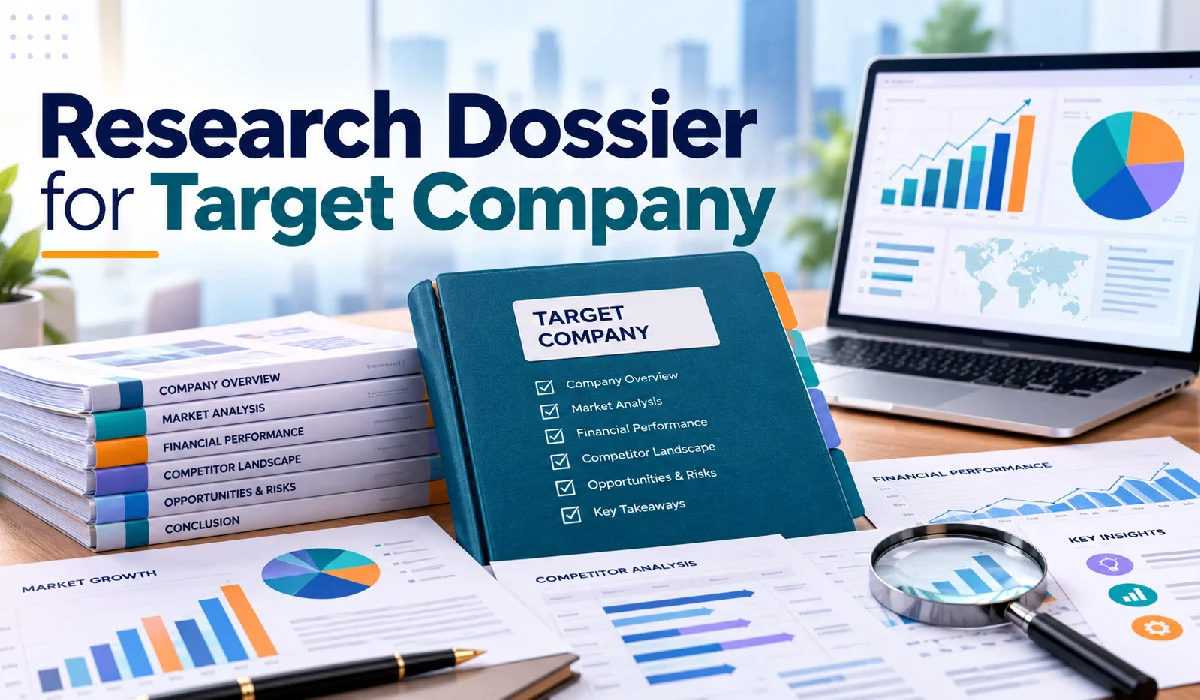
Understanding a company requires more than reading its website or looking at a few financial figures. Businesses operate through different departments, leadership structures, products, customers, competitors, and financial arrangements. To understand the complete picture, professionals often prepare a research dossier for a target company.
A research dossier is a structured document that collects important business information and presents it in an organized format. It helps readers understand what a company does, how it operates, where it stands in the market, and what opportunities or risks may affect its future.
This type of research is useful for sales professionals, investors, marketing agencies, business consultants, recruiters, journalists, and entrepreneurs. Whether someone is preparing for a business meeting, evaluating a potential partner, or studying a competitor, a well-prepared dossier provides a useful foundation for making informed decisions.
What Is a Research Dossier for Target Company?
A research dossier for a target company is a detailed business profile containing relevant information about a specific organization. It combines company background, leadership details, products, services, financial information, market position, competitors, and other important findings.
The word target refers to the organization being investigated. It might be a potential customer, business partner, competitor, investment opportunity, supplier, acquisition candidate, or prospective employer.
Unlike a short company profile, a research dossier goes beyond basic facts. It explains how different parts of the business connect and identifies information that may influence a particular decision.
For example, a marketing agency researching a potential client may examine its website, services, target audience, marketing activities, and competitors. An investor may focus more heavily on financial statements, ownership, debt, and business performance.
Why Company Research Matters
Company research helps professionals understand an organization before making important business decisions. Without sufficient information, it is easy to misunderstand a company’s needs, financial condition, reputation, or market position.
A research dossier brings relevant information together, making it easier to identify strengths, weaknesses, opportunities, and possible concerns.
For sales teams, it supports more relevant conversations with potential customers. Investors can use it to organize information before evaluating an investment. Business developers can assess whether a partnership makes commercial sense.
It also saves time. Instead of repeatedly searching for company details, professionals can refer to one organized document containing important facts, source links, and research notes.
Main Objectives
The purpose of a research dossier depends on the reason for investigating a company. However, most dossiers share several common objectives.
Understanding the business: Identify the company’s main activities, products, services, customers, and business model.
Evaluating financial performance: Examine available revenue, profitability, expenses, cash flow, and debt information.
Identifying decision-makers: Understand the leadership team, directors, ownership structure, and relevant departments.
Studying competitors: Compare the company with other organizations operating in the same market.
Finding opportunities: Identify potential sales opportunities, partnership possibilities, investment interests, or areas for improvement.
Recognizing risks: Investigate legal issues, financial weaknesses, market challenges, and reputational concerns.
A useful dossier connects these findings with the specific decision the researcher needs to make.
Essential Information to Include
A strong company research dossier should contain several important sections. The exact structure can change depending on the company’s size, industry, and research objective.
1. Company Overview
The company overview introduces the organization and provides its basic identity. It usually includes the official business name, website, industry, headquarters, registration details, founding year, and primary business activities.
This section should explain what the company does in straightforward language. Readers should understand its main products or services without needing to investigate several additional sources.
It is also helpful to identify the company’s parent organization, subsidiaries, and major business divisions where this information is publicly available.
2. History and Background
A company’s history provides context about how it developed. This section may include its founding date, original purpose, major milestones, important changes, acquisitions, and expansion into new markets.
Understanding the background can help explain the organization’s current position. For example, a company that began as a small regional business may have expanded internationally through acquisitions or new product development.
Researchers should use company records, archived announcements, credible news reports, and official documents to confirm historical details.
3. Leadership and Ownership
Leadership information helps researchers identify the people responsible for important business decisions.
This section may include the chief executive officer, managing director, founders, board members, senior executives, and major shareholders.
It is also useful to understand the ownership structure. A company may be privately owned, publicly traded, family controlled, or part of a larger corporate group.
For private organizations, ownership details may be limited. Researchers should clearly distinguish confirmed information from assumptions and avoid presenting incomplete shareholder information as a complete ownership record.
4. Products and Services
This section explains what the company sells and how its offerings meet customer needs.
Researchers should list major products, service categories, subscription plans, pricing structures, and important product features where publicly available.
It is also useful to understand which products appear most important to the company’s business model. Some organizations depend on one main product, while others generate income through several services.
Reviewing product pages, brochures, pricing information, and customer documentation can provide a better understanding of the company’s commercial activities.
5. Financial Information
Financial research is one of the most important parts of a company dossier, especially when evaluating investments, suppliers, or potential business partners.
For publicly reporting companies, useful information may include revenue, operating income, net profit, assets, liabilities, cash flow, and outstanding debt.
Researchers should examine multiple reporting periods instead of relying on one financial year. This makes it easier to identify growth patterns, declining performance, and changes in operating costs.
Private companies may not publish detailed financial statements. In these situations, the dossier should explain that information is unavailable rather than inventing financial figures.
6. Market Position
Market position describes how a company competes within its industry. This section examines its target market, geographical reach, customer segments, brand recognition, and competitive strengths.
For example, a software company may compete through pricing, product functionality, customer support, or specialist features.
Researchers should also examine industry developments that may influence the organization. Changes in technology, customer behavior, regulations, and economic conditions can affect its future performance.
7. Competitor Analysis
Competitor analysis identifies other businesses offering similar products or services to the same audience.
A useful comparison considers pricing, product quality, market coverage, customer reviews, brand positioning, and available features.
It is important to distinguish direct competitors from indirect competitors. Direct competitors offer similar solutions, while indirect competitors may satisfy the same customer need through a different approach.
Comparing several relevant businesses helps explain where the target company performs well and where it may face pressure.
8. Customers and Target Audience
Understanding customers is essential when preparing a dossier for sales, marketing, and business development.
This section examines the company’s likely customer groups, industry sectors, geographical markets, and purchasing requirements.
For business-to-business organizations, customers may include corporations, government agencies, retailers, or professional service providers.
For consumer brands, the target audience may be identified through product categories, customer surveys, marketing materials, and public market research.
Customer information should be based on available evidence rather than assumptions about individual buyers.
9. Online Presence and Reputation
A company’s online presence can provide valuable information about its brand, communication style, and customer relationships.
Researchers should examine the official website, social media accounts, published articles, press releases, and customer feedback.
LinkedIn may provide information about the company’s workforce and professional activities. Other social platforms can help reveal how the organization communicates with its audience.
Reviews and public discussions may identify recurring customer concerns. However, individual reviews should not be treated as conclusive proof of overall business quality.
10. Risks and Opportunities
Every company faces risks that may affect its operations or future performance.
These can include financial pressure, legal disputes, regulatory changes, supply chain problems, strong competition, cybersecurity issues, or declining customer demand.
Opportunities may include entering new markets, launching additional products, forming partnerships, improving technology, or expanding an existing customer base.
A useful dossier explains why each risk or opportunity matters and identifies the available evidence supporting the assessment.
Types of Company Research Dossiers
Different business situations require different research approaches.
Sales research dossier: Focuses on potential customers, decision-makers, business needs, purchasing signals, and sales opportunities.
Investment research dossier: Examines financial performance, ownership, valuation, debt, industry conditions, and investment risks.
Competitor research dossier: Compares products, prices, marketing strategies, customers, and competitive advantages.
Due diligence dossier: Investigates legal identity, ownership, financial condition, regulatory matters, contracts, and other relevant risks.
Partnership research dossier: Evaluates business compatibility, reputation, capabilities, financial stability, and potential commercial benefits.
Recruitment research dossier: Helps job candidates understand an employer’s operations, culture, leadership, business performance, and recent developments.
The best format is the one that answers the questions connected to the researcher’s actual objective.
Where to Find Reliable Company Information
The quality of a dossier depends heavily on the sources used. Researchers should prioritize official records and original documents whenever possible.
Company websites: About pages, product information, leadership biographies, press releases, and corporate announcements provide an initial overview.
Annual reports: Public companies often publish detailed reports covering financial performance, strategy, management, and business risks.
Government business registries: Official registries can provide legal company names, registration status, directors, and available filing records.
Securities regulators: Public-company disclosures provide financial statements and important corporate announcements.
Stock exchanges: Listed-company pages can provide trading information, financial disclosures, and corporate announcements.
Business news publications: Credible reporting can provide information about acquisitions, leadership changes, market developments, and legal events.
Industry research: Trade publications and market reports help explain broader industry conditions and competitive trends.
Examples of useful research resources include SEC EDGAR in the United States, Companies House in the United Kingdom, and the Securities and Exchange Commission of Pakistan for relevant Pakistani corporate and securities information.
How to Prepare a Research Dossier Step by Step
Preparing a useful dossier becomes easier when the research follows a consistent process.
Step 1: Define the objective. Decide why the company is being researched. A sales dossier will require different information from an investment or acquisition report.
Step 2: Identify the correct company. Confirm its legal name, website, registration location, and company number where available. This helps avoid confusing businesses with similar names.
Step 3: Collect basic information. Start with the official website, company profile, product pages, and publicly available announcements.
Step 4: Research leadership and ownership. Identify relevant executives, directors, founders, and shareholders using reliable records.
Step 5: Examine financial information. Review annual reports, financial statements, funding announcements, and other relevant records.
Step 6: Analyze the market. Identify competitors, customer segments, industry conditions, and important market developments.
Step 7: Evaluate risks and opportunities. Organize findings into practical categories and explain their potential importance.
Step 8: Verify the information. Check important claims against original sources and compare information from independent publications.
Step 9: Write the final report. Present the findings using short sections, clear headings, source references, and a concise executive summary.
Tools Used for Company Research
Several research platforms can help professionals
collect and organize business information.
SEC EDGAR provides access to filings submitted by companies and other reporting organizations in the United States.
Companies House offers public information about UK-registered companies, including filing histories and available officer information.
OpenCorporates provides a searchable database of corporate records collected from different jurisdictions.
LinkedIn can help researchers examine professional profiles, company pages, and publicly visible recruitment activity.
Google Search and Google News are useful for finding official announcements, media coverage, and industry developments.
AnnualReports.com provides access to annual reports from participating public companies.
These tools have different coverage and limitations. Some information is free, while certain commercial databases require subscriptions. Researchers should always confirm important details with primary records where possible.
SWOT Analysis
A SWOT analysis is a useful way to summarize a company’s competitive position.
It divides findings into four categories:
- Strengths: Internal advantages such as a recognized brand, skilled workforce, strong distribution, or valuable products.
- Weaknesses: Internal limitations such as high operating costs, limited resources, or dependence on a small customer group.
- Opportunities: External possibilities such as new markets, technological developments, or changing customer demand.
- Threats: External challenges such as new competitors, regulation, economic pressure, and supply chain disruptions.
A SWOT analysis should be based on evidence gathered during the research process. It should not simply list general business statements that could apply to any organization.
Common Research Mistakes
Even a detailed company dossier can become unreliable if the research process is poorly managed.
One common mistake is depending entirely on the company’s own website. Official information is valuable, but it should be compared with independent sources and public records.
Another mistake is using outdated financial information. A company’s performance can change significantly within a year, so researchers should record the reporting period and publication date.
Confusing businesses with similar names is another problem. Legal names, registration numbers, and official websites help establish the correct identity.
Researchers should also avoid treating estimates as confirmed facts. If revenue, ownership, or customer information cannot be verified, the dossier should clearly identify the information gap.
Finally, collecting large amounts of information without a clear objective can make the report difficult to use. Every section should contribute to the decision the dossier is intended to support.
Benefits and Limitations
A research dossier offers several practical benefits. It organizes scattered information, improves preparation, supports comparisons, and helps professionals identify relevant business opportunities.
It can also improve communication between teams. Sales, marketing, finance, and management professionals can refer to the same structured findings when discussing a target organization.
However, a dossier cannot guarantee that a business decision will be successful. Public information may be incomplete, private-company records may be limited, and financial estimates may not reflect current conditions.
There is also a difference between collecting information and understanding it. A strong dossier needs analysis, not simply a collection of copied facts.
Its real value comes from accurate information, clear reasoning, and relevant conclusions.
Best Practices
A professional company dossier should follow a few basic standards.
Use reliable and preferably primary sources. Add publication dates to financial information and company announcements. Keep source links beside the claims they support.
Separate confirmed facts from estimates and professional opinions. If a detail cannot be verified, label it as unavailable rather than filling the gap with speculation.
Keep the report organized and relevant to its purpose. A short executive summary should explain the most important findings, while detailed sections provide supporting information.
Finally, review the dossier regularly. New financial results, leadership changes, acquisitions, and market developments can make previous findings outdated.
Final Thoughts
A research dossier for target company is a practical resource for understanding an organization’s background, operations, finances, leadership, competitors, and market position.
It supports a wide range of professional activities, from sales preparation and recruitment to investment research and business due diligence.
The most effective dossiers are not necessarily the longest. They are the ones that answer important questions using reliable sources, clear analysis, and properly documented findings.
By following a structured research process, professionals can turn scattered company information into a useful business intelligence report. This makes it easier to evaluate opportunities, recognize potential risks, and approach important business decisions with greater confidence.
FAQs
1. What is a research dossier for a target company?
It is a structured business report containing company information, financial details, leadership, products, competitors, market position, and potential risks.
2. What information should a company research dossier include?
It should include the company overview, history, ownership, management, financial performance, products, customers, competitors, online presence, and SWOT analysis.
3. Who uses company research dossiers?
Sales professionals, investors, business consultants, marketing agencies, recruiters, journalists, and entrepreneurs use them to understand organizations and evaluate business opportunities.
4. Where can I find reliable company information?
Useful sources include official company websites, annual reports, government business registries, securities regulators, stock exchanges, and reputable business news publications.
5. Is a company research dossier the same as due diligence?
No. A research dossier is a broader information document, while due diligence is a more detailed investigation conducted before important decisions such as investments, acquisitions, and partnerships.






Leave a Reply