

Clive Woodward is, without a doubt, one of the most remarkable figures in the history of sport. Whether you’re a die-hard rugby fan or someone who simply admires great leadership, his story is the kind that genuinely gets your blood pumping. From his early days as a sharp and elusive centre on the rugby field to his extraordinary tenure as the architect of England’s greatest sporting triumph — the 2003 Rugby World Cup — Sir Clive Woodward has left a legacy that will never be forgotten. And well, it’s not just about rugby. His influence stretches into business, the Olympics, and beyond. Let’s dive right in.
The Early Life of Clive Woodward: Where It All Began
Sir Clive Ronald Woodward OBE was born on 6 January 1956 in Ely, Cambridgeshire, the son of an RAF pilot. Growing up in a family shaped by discipline and dedication, Clive was exposed to a culture of high expectations from a very young age. He started school at Corstorphine in Edinburgh and was later sent to the school ship HMS Conway, as his father disapproved of his ambition to play professional football.
Interestingly, it was at Conway that rugby entered his life in a big way. At Conway, he played rugby union at centre alongside fly-half Iain Duncan Smith, who would later become leader of the Conservative Party. What a pair they must have been! Clive was clearly gifted on the field — so gifted, in fact, that according to Woodward, he was not selected to play for the Welsh Schoolboys side because he was English, but he was good enough to play rugby union for a Welsh school.
He obtained a degree in Sports Science from Loughborough University where he captained the Loughborough University rugby XV. It was here that his coaching philosophy was first shaped. Heavily influenced by the teachings of Jim Greenwood while a student at Loughborough University, Woodward enjoyed an outstanding coaching career where his visionary and innovative approach and attention to detail saw England overcome several setbacks before establishing themselves as the world’s number one side.
Clive Woodward as a Rugby Player: A Career Worth Celebrating
Before he became a legendary coach, Clive Woodward was a seriously impressive player. Clive Woodward made 148 appearances as a player for Leicester Tigers between 1979 and 1985, including three John Player Cup Finals. That’s not a small feat — that’s a career any rugby player would be proud of.
Woodward scored 43 tries as an elusive and inventive centre at Tigers and gained the first of his 21 England caps in the Grand Slam season of 1980. He also represented the British & Irish Lions in 1980 and 1983.
Here’s a quick snapshot of his playing career:
| Club/Team | Period | Role |
| Harlequins | 1974 | Centre |
| Loughborough Students | Mid-1970s | Centre |
| Leicester Tigers | 1979–1985 | Centre |
| Manly (Australia) | Mid-1980s | Centre |
| England | 1980–1984 | Centre (21 caps) |
| British & Irish Lions | 1980 & 1983 | Centre |
Some have since said that even then, he was ahead of his time, an exciting and elusive player. He wasn’t just fast with his feet — he was sharp with his mind too, and that mental acuity would later define his coaching genius.
From the Boardroom to the Touchline: Woodward’s Business Background
Here’s something that sets Clive Woodward apart from most other coaches — he didn’t just come from rugby. He came from business too, and that combination proved to be explosive.
Prior to his full time coaching career, Clive spent nine years with Xerox in the UK and Australia before establishing his own finance and leasing company. Returning to England five years later he established his own successful computer leasing company in Maidenhead and began his remarkable career as a rugby coach with the nearby Henley club.
This business experience wasn’t just background noise — it completely shaped how Woodward approached coaching. He brought concepts like strategic planning, long-term goal setting, individual development, and performance measurement into a sport that had largely operated on tradition and instinct. Blimey, what a breath of fresh air that must have been!
He immediately transformed the traditional practices of previous set-ups, introducing business principles, setting long term goals, paying attention to detail and planning the personal development of individuals in the basic skills, tactics and strategy of modern rugby.
Rising Through the Coaching Ranks: From Henley to England
Clive’s coaching journey didn’t start at the top — it started at the bottom, and it grew with every step. His coaching career began soon after he returned to the UK at Henley. Under Clive’s leadership, the club gained three promotions in three successive seasons. Three promotions in a row! That kind of early success was a clear sign that this man had something special.
From there, he moved on to bigger stages. After coaching with Henley, London Irish and Bath, Clive Woodward took up the England job in 1997.
Appointed England’s first full-time professional coach in 1997, Woodward took charge of 83 matches, 59 of which were won. That’s a win rate any coach would dream of. His early days weren’t without challenges, mind you. Having been quoted as requesting that the press judge him on England’s performance at the 1999 Rugby World Cup, when they were beaten by South Africa, his job was questioned. But Woodward didn’t crumble under pressure — he regrouped, rebuilt, and came back stronger.
The 2003 Rugby World Cup: England’s Greatest Hour

If there’s one moment that defines Clive Woodward, it’s the 2003 Rugby World Cup. This wasn’t just a tournament win — it was the culmination of years of hard work, innovative thinking, and relentless pursuit of excellence.
England were Six Nations champions in 2000 and 2001, and completed the Grand Slam in 2003 with an emphatic 42–6 victory over Ireland in Dublin. But Woodward wasn’t done there. England followed up by defeating the All Blacks in New Zealand for the first time since 1973, holding out for a 15–13 win despite being reduced to 13 men in the second half with two forwards in the sin bin. A week later reigning world champions Australia were beaten 25–14 in Melbourne, England’s first ever win on Australian soil.
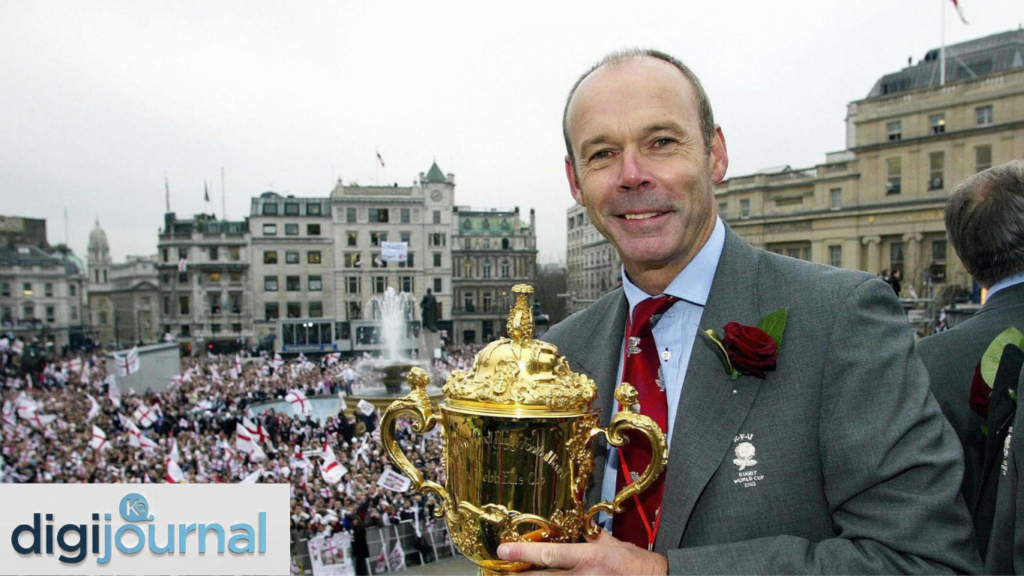
And then came the greatest prize of all. Sir Clive Woodward is the World Cup winning Head Coach who led England’s rugby players to World Cup glory in Australia in 2003.
The key achievements during Woodward’s tenure as England coach include:
- Three Six Nations Championships (2000, 2001, 2003)
- Grand Slam victory in 2003
- First win against New Zealand in New Zealand since 1973
- First ever win on Australian soil
- 2003 Rugby World Cup victory — England’s first and only World Cup title
- England ranked No. 1 in the world
In a period which saw the team achieve 22 consecutive wins at Twickenham, 14 consecutive wins in international matches — the England team under Woodward was a force that simply could not be stopped.
Woodward’s Coaching Philosophy: Building Champions from the Inside Out
What truly separates Clive Woodward from the pack is his coaching philosophy. It wasn’t just about tactics on the field — it was about building complete human beings who performed under pressure. You could say he was crafting champions, not just rugby players.
Based on the notion that “Great Teams Are Made of Great Individuals”, Clive Woodward has identified four criteria that characterise a champion individual or team in business and sport. These four pillars — Leadership, Teamship, Partnership, and Attention to Detail — became the foundation of his entire coaching model.
Here’s a closer look at each:
- Leadership: Clive believed every individual within a team must take personal responsibility. It wasn’t just the captain who led — everyone led in their own role.
- Teamship: Understanding that the collective is stronger than the individual, Woodward created an environment where players supported and pushed each other relentlessly.
- Partnership: He built bridges between coaching staff, medical teams, analysts, and players — creating a seamless, fully integrated unit.
- Attention to Detail: Perhaps his most famous trait. Woodward left nothing to chance. From training schedules to hotel arrangements, every detail was scrutinised and optimised.
During his time with the England team, Clive established high-performance management systems that incorporated players, coaches, and technical, medical, and administrative units. This was revolutionary at the time, and honestly, it’s still a benchmark for team management today.
Life After Rugby: The British Olympics and Beyond
After leaving the England rugby job in 2004, Clive Woodward didn’t exactly retire to a garden chair. Far from it! He took on one of the biggest challenges in British sport.
In 2006 Clive joined the leadership team at the British Olympic Association as Director of Sport for Team GB where he worked with all key stakeholders in British sport to support our athletes and coaches at the Beijing, Vancouver and London Games.
In preparation for London 2012, Clive also established his “One Team” philosophy across the 26 sports to drive performance under the intense pressure of a home game. And the results? Absolutely outstanding. Clive was delighted to accept the role of Team GB’s Director of Sport in 2006. As Team GB’s Director of Sport Clive worked in close partnership with key stakeholders in British Sport to support the national coaches and athletes at the Beijing & Vancouver Olympics as well as deliver Team GB’s most successful Olympic Games in the modern era at London 2012.
London 2012 is widely regarded as the pinnacle of British Olympic performance — and Clive Woodward was at the heart of that achievement.
His roles and contributions beyond rugby are summarised here:
| Role | Organisation | Period |
| Head Coach | British & Irish Lions | 2005 |
| Performance Director | Southampton FC | 2004–2006 |
| Director of Football | Southampton FC | 2006 |
| Director of Elite Performance | British Olympic Association | 2006–2012 |
| Pundit & Analyst | ITV Sport | Ongoing |
| IOC Entourage Commission Member | International Olympic Committee | 2012–Present |
Clive Woodward as a Business Leader and Keynote Speaker
Today, Clive Woodward continues to inspire — not just in sport, but in the world of business. His story is proof that the same principles that build championship teams can build successful companies too.
Clive’s methods are not based on theory but rather, his unrivalled experience of working with high performing individuals, teams and organisations in international sport and business.
His flagship talks cover themes such as:
- “The DNA of a Champion” — identifying what separates good from truly great
- “Winning Culture” — creating an environment where everyone thrives
- “Relentless Learning” — the power of continuous growth and adaptation
- “Tackling Change” — how to lead innovation in uncertain times
Focused on “creating an environment so good that everyone wants to be a part of and nobody ever wants to leave,” Clive’s talk on creating a Winning Culture encapsulates the collaborative leadership model Clive Woodward successfully applied to the World Cup-winning England rugby team and Team GB at London 2012.
He’s also the founder of Hive Learning — a digital platform that brings his coaching methods to organisations worldwide. Clive is currently the Founder and Chairman of Hive Learning – an app which has digitised Clive’s coaching methods and is designed to improve the quality of learning in business and sport.
Honours, Legacy, and What Makes Clive Woodward Truly Special
The awards and recognition that Clive Woodward has received are a true reflection of his stature in the world of sport. Knighted in the 2004 New Year Honour’s List, Sir Clive became one of the most decorated figures in British sporting history.
But beyond trophies and titles, what makes Woodward truly special is his mindset. He once said — and it’s a quote that really sticks — “I never lose, I either win or learn.” That attitude of relentless learning, of refusing to see failure as an endpoint, is the thread that runs through every chapter of his story.
Clive continues to support the development of athletes and coaches via his position on the IOC’s Entourage Commission, which he has held since 2012. Clive also supports aspiring athletes and coaches through a bespoke scholarship programme in partnership with investors from the corporate world.
Conclusion
In summing it all up, Clive Woodward is far more than a rugby coach who won a World Cup. He is a visionary leader, a relentless learner, and a man who transformed an entire sport — and then went on to transform British Olympic sport as well. His story is a masterclass in what happens when talent meets preparation, when passion meets professionalism, and when a determined individual refuses to accept mediocrity.
From the fields of Leicester to the stadiums of Sydney, from the business world of Xerox to the corridors of the British Olympic Association — Clive Woodward has lived a life defined by excellence. His four pillars of Leadership, Teamship, Partnership, and Attention to Detail are not just coaching concepts; they’re a blueprint for success in any field.
Whether you’re a student of sport, a business leader, or simply someone who admires the art of building great teams, there is so much to learn from Clive Woodward.
FAQs
Who is Clive Woodward?
Clive Woodward is a former England rugby union player and the coach who led England to victory in the 2003 Rugby World Cup. He is also a former Director of Elite Performance for Team GB and a renowned business speaker.
When did Clive Woodward become England coach?
Clive Woodward became England’s coach in 1997, becoming the team’s first ever full-time professional head coach appointed by the Rugby Football Union.
What did Clive Woodward do after rugby?
After leaving the England rugby role in 2004, Clive Woodward became Director of Sport for Team GB at the British Olympic Association, a role he held from 2006 to 2012, during which time he helped oversee Team GB’s historic performance at the London 2012 Olympics.
